What parametric insurance actually does
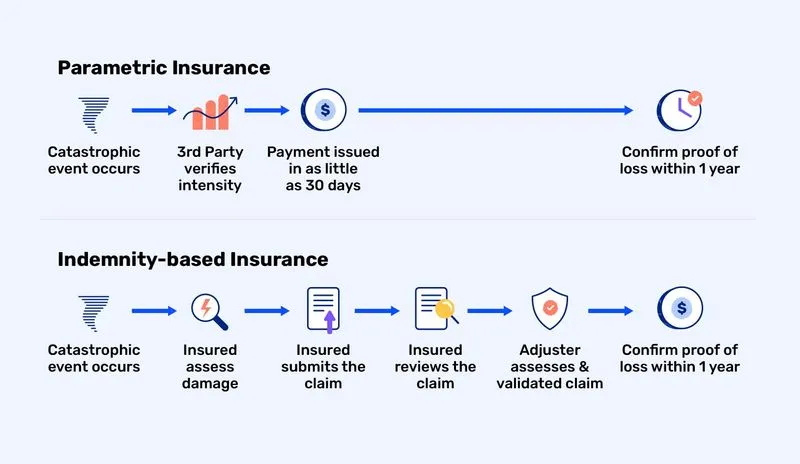
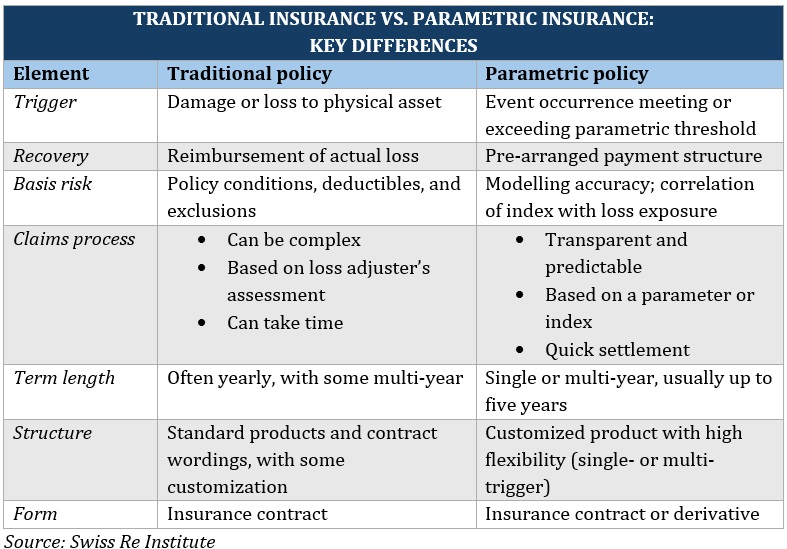
Parametric insurance is a coverage model that pays out based on the severity of an event rather than the actual financial loss suffered by the policyholder. Traditional indemnity insurance requires a lengthy investigation to verify damages before issuing a payout. In contrast, parametric insurance relies on a predefined trigger—such as wind speed, earthquake magnitude, or rainfall levels—that is measured by an independent, objective source.
This fundamental difference shifts the focus from loss assessment to event measurement. When the trigger threshold is reached, the payout is automatic. There is no need to prove that your specific roof was damaged by a hurricane; if the anemometer records winds exceeding 100 mph, the contract activates. This mechanism eliminates the ambiguity and delays often associated with traditional claims processing, providing immediate liquidity when it is needed most.
By removing the claims adjustment process, parametric insurance fills protection gaps that traditional policies often leave open, such as business interruption or supply chain disruptions. It expands coverage beyond physical assets to address risks that are difficult to quantify under standard indemnity models. For businesses and individuals seeking speed and certainty, this trigger-based approach offers a distinct alternative to conventional risk management.
Comprehensive Guide to Parametric Insurance
How onchain infrastructure enables instant payouts
Traditional insurance relies on a slow, manual claims process. After a disaster, adjusters assess damage, verify losses, and approve payments—a cycle that can take weeks or months. For a business or individual facing immediate financial strain, this delay can be devastating. Parametric insurance eliminates this bottleneck by replacing subjective loss assessment with objective, automated triggers.
The engine behind this speed is onchain infrastructure, specifically the combination of smart contracts and data oracles. Smart contracts are self-executing agreements with the terms of the contract directly written into code. In the context of a parametric insurance guide, these contracts hold the premium funds and define the exact conditions under which a payout occurs. Unlike traditional policies that require human interpretation, the code executes automatically when conditions are met.
However, smart contracts cannot access real-world data on their own. This is where oracles come in. Oracles act as secure bridges between the blockchain and external data sources, such as weather stations, seismic sensors, or government disaster declarations. When a predefined parameter is reached—such as wind speeds exceeding 100 mph or rainfall dropping below a specific threshold—the oracle feeds this verified data to the smart contract. The contract then instantly triggers the payout to the insured party's wallet.
This mechanism transforms insurance from a reactive administrative task into a proactive, automated financial instrument. The result is near-instant settlement, providing liquidity exactly when it is needed most. By removing the friction of claims processing, onchain infrastructure ensures that coverage functions as true risk management rather than just a reimbursement promise.
Key tools for building parametric coverage
Building parametric insurance onchain requires three distinct layers of infrastructure: oracles for data, smart contracts for logic, and liquidity pools for capital. Unlike traditional policies where a claims adjuster investigates damage, these tools work together to trigger payouts automatically when predefined conditions are met.
Data oracles
Oracles act as the bridge between offchain weather or market data and onchain smart contracts. They fetch real-world metrics—such as wind speed, earthquake magnitude, or index prices—and feed them into the blockchain. Without accurate, tamper-proof oracles, the parametric trigger cannot function. The integrity of the entire policy depends on the oracle’s ability to deliver verified data without delay.
Smart contract templates
Smart contracts encode the insurance logic. They define the trigger thresholds, the payout amounts, and the conditions for settlement. Once the oracle delivers the data, the contract evaluates it against the agreed-upon parameters. If the data meets the criteria, the contract executes the payout immediately. This removes the need for manual claims processing, reducing administrative costs and eliminating delays.
Liquidity pools
Liquidity pools provide the capital necessary to pay out claims. Instead of relying on traditional reinsurance markets, parametric insurance often uses decentralized liquidity providers who stake assets to back the policies. When a trigger event occurs, the smart contract draws from this pool to pay beneficiaries. This model allows for scalable coverage and faster settlement times, as the capital is already onchain and accessible.
The efficiency of parametric insurance hinges on the seamless interaction of these tools. Oracles provide the truth, contracts enforce the rules, and liquidity pools ensure funds are available. Together, they create a system that is transparent, automated, and resilient. This infrastructure is what distinguishes onchain parametric coverage from traditional insurance models.
Navigating basis risk and oracle reliability
Parametric insurance offers speed, but it comes with a specific technical vulnerability: basis risk. This is the gap between the index data that triggers a payout and the actual financial loss you suffer. In traditional indemnity insurance, the payout matches the repair cost. In parametric models, the payout matches a predefined metric, like wind speed or earthquake magnitude.
These two numbers rarely align perfectly. You might experience a hurricane with winds of 100 mph, triggering your parametric payout, but your roof only sustained minor damage because it was built to higher codes. Conversely, you could suffer total structural failure from a 95 mph storm that falls just below your 100 mph trigger threshold. In this scenario, you have no coverage despite having a significant loss. This disconnect is the fundamental trade-off for getting paid in days rather than months.
To mitigate basis risk, you must choose indices that closely mirror your specific exposure. A general regional wind index might not account for local microclimates or your building’s specific elevation. The closer the index is to your actual asset, the lower the basis risk. However, hyper-local data is often scarce or expensive to acquire, forcing many policyholders to accept a broader, less precise index.
The second major risk lies in the oracle—the data provider that feeds information to the smart contract. If the oracle is manipulated or fails, the contract executes incorrectly. Since blockchain transactions are immutable, a wrong payout based on bad data is irreversible. This makes the choice of oracle critically important.
Reliable parametric insurance relies on decentralized oracles that aggregate data from multiple independent sources. This redundancy makes it difficult for a single point of failure or malicious actor to skew the result. Always verify that the oracle network has a proven track record of accuracy and resilience against manipulation. Without robust oracle infrastructure, the promise of automated, trustless insurance collapses.
Helpful gear
Use these product recommendations as a starting point, then choose the size, material, and price point that fit how you actually use the gear.



As an Amazon Associate, we may earn from qualifying purchases.
No comments yet. Be the first to share your thoughts!