Defining parametric insurance mechanics
Parametric insurance analysis begins by understanding how it differs from traditional coverage. Standard indemnity insurance waits for a loss to occur, assesses the damage, and then pays out based on the actual financial harm. Parametric insurance skips the claims adjustment entirely. Instead, it ties payouts to a predefined objective index, such as wind speed or seismic acceleration. If the data meets the threshold, the payout happens automatically, regardless of whether the insured property was actually damaged.
This distinction is critical for onchain risk transfer. The mechanism relies on the probability of an event rather than the probability of a loss. As Swiss Re Corporate Solutions notes, these solutions cover the likelihood of a loss-causing event triggering a specific data point. The policy agrees in advance to make a payment dependent on an external index, effectively removing the ambiguity of loss assessment.
Consider how the Wharton School illustrates this with disaster examples. A hurricane policy might pay a set dollar amount whenever wind speeds exceed a certain level in a particular location. Similarly, an earthquake product might trigger a payment when peak ground acceleration exceeds a threshold at a pre-defined location. The trigger is binary and measurable, ensuring liquidity arrives when it is needed most, without waiting for adjusters to visit the site.
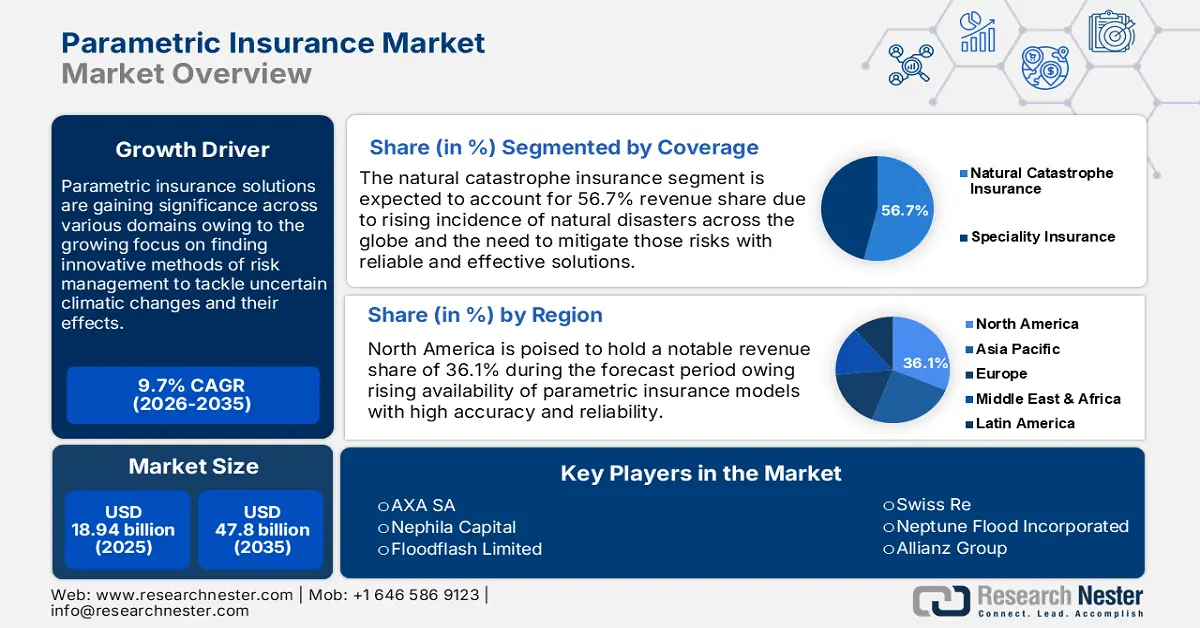
The market is expanding rapidly as institutions recognize the efficiency of this model. GMI estimates the global parametric insurance market at USD 19.4 billion in 2025, with projections reaching USD 63.8 billion by 2035. This growth reflects a shift toward solutions that prioritize speed and transparency over traditional indemnity processes.
Market growth and capital inflows
The global parametric insurance market is expanding rapidly, driven by a need for faster, more transparent risk transfer mechanisms. According to Global Market Insights (GMI), the market was valued at approximately $19.4 billion in 2025 and is projected to reach $63.8 billion by 2035 [src-serp-3]. This trajectory highlights the increasing financial gravity of the sector as institutions seek alternatives to traditional indemnity models.
The Society of Actuaries (SOA) provides a slightly more conservative but still robust outlook, estimating global premiums at $16.2 billion in 2024 with a projection to hit $51.3 billion by 2034 [src-serp-6]. While valuation methodologies vary slightly between firms, all major research bodies agree on the direction: capital is flowing into parametric solutions at an accelerating pace. This growth is not merely speculative; it reflects a structural shift in how risks are priced and transferred in an increasingly volatile world.
For a parametric insurance analysis, understanding this capital inflow is essential. It indicates that insurers, reinsurers, and institutional investors are no longer treating these products as niche experiments. Instead, they are becoming a core component of risk management portfolios. The convergence of data availability, blockchain infrastructure, and climate uncertainty is creating a fertile environment for this growth, turning what was once a theoretical concept into a tangible asset class.
Oracle Infrastructure: The Real Bottleneck
The elegance of parametric insurance analysis lies in its simplicity: a specific event occurs, and a payout follows automatically. But in the onchain world, that "event" is just data. If the data is wrong, the payout is wrong. This is why oracle infrastructure is the single most critical bottleneck in onchain risk transfer.
Traditional insurance relies on adjusters to assess actual loss. Onchain parametric policies rely on indices. A hurricane might trigger a payout based on wind speed data from NOAA, not the actual damage to a specific roof. This distinction is vital. It allows for speed and trustlessness but introduces a new risk vector: data integrity. If the oracle feeding that wind speed data is compromised, the smart contract executes correctly, but the result is financially devastating for the wrong party.
This is why the shift from centralized data feeds to decentralized oracle networks like Chainlink is not just a technical upgrade—it is a security necessity. Centralized feeds are single points of failure. A hacker compromising one data provider can manipulate the entire insurance protocol. Decentralized networks aggregate data from multiple independent sources, making manipulation economically unfeasible and ensuring that the "trigger" reflects reality, not a glitch or an attack.
Without robust oracle infrastructure, onchain parametric insurance is just a fast way to lose money. The technology only works if the data feeding it is immutable, accurate, and resistant to manipulation.
Comparing Onchain Parametric Protocols
To conduct a thorough parametric insurance analysis, we must look past the marketing and examine the mechanics that actually drive payouts. Unlike traditional policies that indemnify pure loss, these protocols pay out based on a predefined index. This distinction is critical: the trigger is data, not damage assessment.
The table below compares major onchain players by their trigger mechanisms and oracle sources. Understanding these differences reveals how each protocol mitigates basis risk—the gap between the index payout and your actual loss.
| Protocol | Primary Trigger | Oracle Source | Coverage Scope |
|---|---|---|---|
| Nexus Mutual | Smart contract exploit | On-chain events, external audits | DeFi protocol exploits |
| Etherisc | Flight delay, weather index | Oracle Network (chainlink) | Travel, crop, weather |
| Hedgey | Stablecoin depeg | Chainlink Price Feeds | DeFi stablecoin failure |
| Arbol | Earthquake magnitude | USGS, EMSC | Property damage, business interruption |
Oracle Reliability and Trigger Types
The integrity of a parametric policy rests entirely on its oracle. If the data source is manipulated or delayed, the payout fails. Nexus Mutual relies heavily on on-chain event verification and external audit reports, making it specific to smart contract risks. In contrast, Etherisc and Arbol depend on external data providers like Chainlink or USGS for physical world events.
This separation creates a unique risk profile. You are not insuring against the event itself, but against the accuracy of the index. For example, a flight delay policy might pay out if the airport’s official log shows a 2-hour delay, even if your specific flight was cancelled earlier. This is the essence of index-based solutions: they cover the probability of an event, not the nuance of individual loss.
Coverage Scope and Basis Risk
Each protocol targets a specific slice of the risk landscape. DeFi-native protocols like Hedgey focus on financial indices, such as stablecoin depegs, offering fast, automated settlements for crypto-native users. Physical-world protocols like Arbol address catastrophe risks, providing liquidity for property owners when earthquakes exceed a certain magnitude.
When evaluating these options, consider the basis risk. A parametric policy for hurricanes might pay out when wind speeds exceed 100mph in a specific location. If your property was damaged by flooding rather than wind, you receive the payout but may not have covered the actual loss. This is why understanding the trigger mechanism is more important than the premium cost.
Basis risk: when the index misses the loss
Parametric insurance analysis must confront a fundamental limitation: the index rarely matches individual loss perfectly. This mismatch, known as basis risk, creates a gap between the payout triggered by data and the actual financial hit suffered by the policyholder. In traditional indemnity models, the insurer pays for verified damage. In parametric models, the insurer pays for a data point.
Consider a hurricane policy triggered by wind speeds exceeding 100 mph at a specific weather station. If a home is destroyed by storm surge but the wind speed at that station remains below the threshold, the payout is zero. Conversely, if winds exceed 100 mph but the home is undamaged, the policy pays out anyway. This is positive basis risk—getting paid for no loss—which can be beneficial but introduces volatility into cash flow planning.
The Wharton School’s research on parametric insurance highlights that this structural disconnect requires careful index design. The goal is to minimize basis risk through precise location data and robust historical correlation, but it cannot be eliminated entirely. For onchain risk transfer, this means smart contracts must account for the possibility of payouts that do not reflect the underlying protocol’s actual economic damage, or failures to pay when damage is real.
No comments yet. Be the first to share your thoughts!