What Parametric Insurance Actually Covers
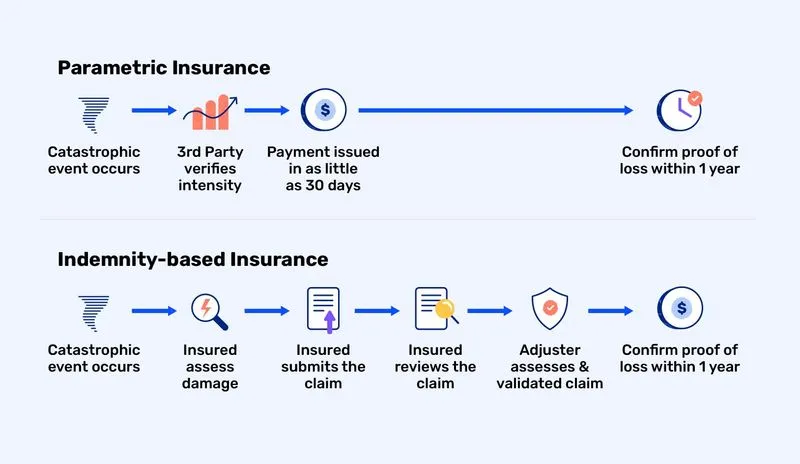
Parametric insurance solves a specific gap left by traditional indemnity policies: the time and friction required to prove a loss. Instead of assessing physical damage after an event, parametric triggers pay out based on a predefined objective index, such as wind speed, rainfall levels, or earthquake magnitude.
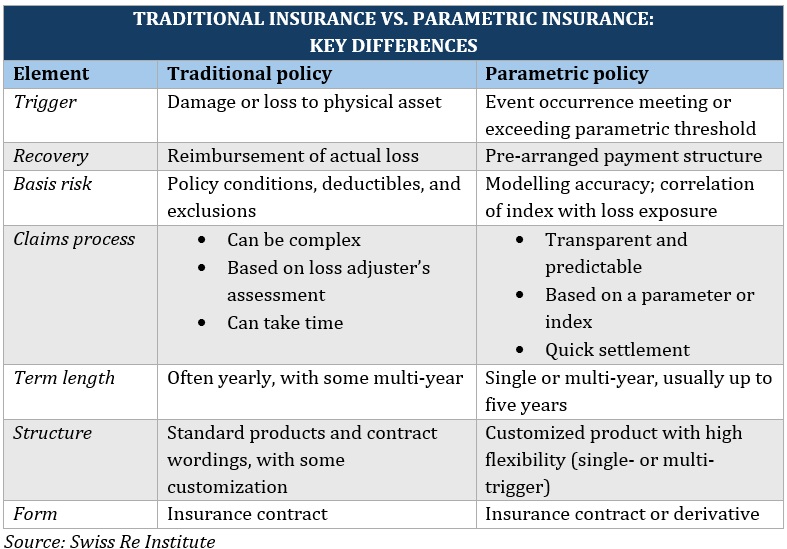
This model expands coverage beyond physical assets to protect against risks that standard indemnity insurance often excludes or leaves partially uncovered. Swiss Re notes that parametric products are particularly effective for filling protection gaps related to deductibles, excluded perils, and scarce resources during large-scale disasters [Swiss Re].
Because the trigger is binary and data-driven, payouts are nearly instantaneous. For DeFi applications, this means liquidity can be deployed to affected parties or liquidity pools the moment an oracle confirms the threshold has been breached, eliminating the months-long claims adjustment process typical of traditional insurance.
Parametric insurance choices that change the plan
Parametric insurance swaps traditional loss adjustment for speed and certainty. You define an objective trigger—like wind speed or earthquake magnitude—and the payout activates automatically when that data point is crossed. This structure removes the need for claims adjusters to visit a site, which is invaluable for rapid DeFi liquidity or post-disaster recovery. However, this efficiency comes with specific structural risks that require careful evaluation.
The primary tradeoff lies in basis risk: the gap between the trigger event and your actual financial loss. A parametric policy might pay out because a hurricane passed nearby, even if your specific asset sustained no damage, or fail to pay if your loss occurred just outside the defined threshold. This mismatch means parametric coverage is rarely a standalone solution; it works best as a layer that fills gaps left by traditional indemnity policies, such as covering deductibles or excluded perils [[src-1]].
Liquidity and capital efficiency are significant advantages. Because payouts are automated via smart contracts and AI-driven oracles, funds are released instantly without bureaucratic delay. This immediacy helps stabilize cash flow during crises, making it particularly attractive for DeFi protocols that need to maintain solvency during market volatility. The speed of execution reduces the administrative burden on both insurers and insured parties, lowering operational costs over time.
However, this reliance on automated oracles introduces oracle risk. If the data source feeding the smart contract is manipulated, delayed, or inaccurate, the payout logic fails. Unlike traditional insurance where disputes can be resolved through legal channels or adjuster investigations, parametric contracts are often immutable once deployed. Ensuring the integrity and redundancy of data feeds is therefore as critical as the insurance terms themselves.
| Factor | Benefit | Tradeoff |
|---|---|---|
| Payout Speed | Instant liquidity via smart contracts | No discretion for complex, partial losses |
| Basis Risk | Predictable, objective triggers | Payout may not match actual asset damage |
| Cost Structure | Lower administrative and claims costs | Premiums may be higher for volatile perils |
| Oracle Dependence | Automated, transparent execution | Vulnerability to data feed manipulation |
The choice to use parametric insurance depends on your tolerance for basis risk versus your need for speed. For standard property or liability, traditional indemnity remains more precise. For systemic shocks, natural catastrophes, or DeFi protocol stability, parametric structures offer unparalleled resilience, provided the triggers are rigorously calibrated to your specific exposure profile.
Choose the next step
Parametric Insurance works best as a clear sequence: define the constraint, compare the realistic options, test the tradeoff, and choose the path with the fewest hidden costs. That order keeps the advice usable instead of decorative. After each step, pause long enough to check whether the recommendation still fits the reader's actual situation. If it depends on perfect timing, unusual access, or a best-case budget, include a simpler fallback.
Spotting Weak Parametric Options
Not all parametric insurance products are built for speed. Many traditional carriers offer "parametric" policies that still rely on manual claims adjustment, defeating the purpose of instant DeFi payouts. These hybrid models often introduce latency, creating a false sense of security for risk managers expecting automated settlement.
When evaluating providers, check the trigger mechanism closely. Weak options often use broad, aggregated data sources that may not reflect your specific exposure. For instance, a regional rainfall index might miss localized flooding at your warehouse. This mismatch leads to coverage gaps where you need protection most, turning a hedge into a liability.
Another common mistake is ignoring basis risk. If the oracle data source lacks transparency or is prone to manipulation, the payout becomes unpredictable. Always verify the oracle's data provenance and fallback mechanisms. Without robust, tamper-proof oracles, the promise of instant liquidity remains just that—a promise, not a guarantee.
Parametric insurance: what to check next
Parametric insurance pays out based on predefined triggers—such as earthquake magnitude or wind speed—rather than assessed physical damage. While AI-driven oracles make these DeFi payouts near-instant, several practical hurdles remain regarding data accuracy, cost, and regulatory status.
Helpful gear
Use these product recommendations as a starting point, then choose the size, material, and price point that fit how you actually use the gear.


As an Amazon Associate, we may earn from qualifying purchases.
No comments yet. Be the first to share your thoughts!