Why parametric insurance fits DeFi
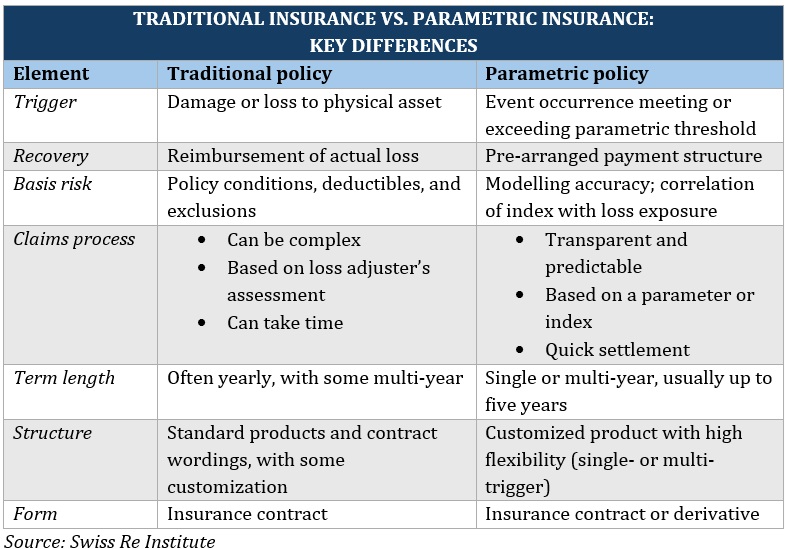
Traditional indemnity insurance relies on assessing actual loss after a disaster occurs. For DeFi, this model is broken. The time between a protocol hack or a market crash and a final payout is often too long to prevent insolvency. Parametric insurance solves this by removing the claims assessment phase entirely. Instead of proving damage, payouts are triggered automatically when specific, objective data points hit pre-defined thresholds.
This approach aligns perfectly with the infrastructure of decentralized finance. Smart contracts can read on-chain data or verified oracle feeds to execute payouts in minutes rather than weeks. As noted by Swiss Re, parametric insurance expands coverage beyond physical assets, filling gaps left by traditional indemnity models [1]. In crypto, the "peril" is often a price drop or a liquidity pool drain, both of which are easily measurable on-chain.
The core benefit is speed and transparency. When a trigger event occurs—such as ETH dropping below a certain price level against a stablecoin—the smart contract verifies the condition and releases funds immediately. There is no ambiguity, no adjuster, and no waiting period. This immediacy is critical for DeFi protocols that operate on thin margins and high velocity.
While parametric insurance does not offer broad coverage for every type of loss [2], it provides a robust safety net for specific, high-impact risks. By focusing on clear triggers, protocols can ensure liquidity is available exactly when it is needed most, stabilizing the ecosystem during volatile market conditions.
Trigger data foundations
Your parametric insurance strategy relies on a single technical truth: the contract pays out based on data, not damage assessments. Traditional insurance waits for adjusters to walk the site. Parametric insurance waits for an oracle to report a number. This shift removes ambiguity but places immense pressure on the accuracy and reliability of the data feeds themselves.
At the core of this mechanism is the oracle. In DeFi, oracles bridge the gap between off-chain real-world events and on-chain smart contracts. They fetch external data—such as ETH price, rainfall levels, or flight delays—and feed it into the blockchain. If the data meets the pre-defined threshold, the smart contract executes the payout automatically. There is no claims process, no human intervention, and no delay. The code is the only judge.
The quality of your strategy depends entirely on the integrity of these feeds. Aon notes that parametric insurance is a "fast-paying risk transfer solution" because it bypasses loss verification. However, this speed is only as good as the data source. If the oracle is compromised or the data feed is delayed, the contract fails. For DeFi applications, this often means using decentralized oracle networks that aggregate data from multiple sources to prevent single-point failures.

Consider the volatility of crypto assets. A standard DeFi position might require protection against a sudden 20% drop in ETH value. Here, the trigger data is the real-time price of ETH. The oracle monitors the price across major exchanges. If the aggregated price falls below your strike price for a sustained period, the insurance contract triggers. This is where technical infrastructure meets financial risk.
The NAIC highlights that this model offers faster payouts by paying set amounts based on event parameters rather than losses. In DeFi, this means your liquidity is preserved instantly. You don't wait for a settlement; you receive stablecoins or the underlying asset immediately upon trigger confirmation. This liquidity is critical for maintaining position solvency during market shocks.
However, selecting the right trigger data requires balancing sensitivity with noise. If your threshold is too tight, you might face "basis risk," where the data triggers a payout even though your specific portfolio wasn't significantly impacted, or worse, fails to trigger when you do need coverage. The oracle must reflect the specific risk you are hedging. For broad market protection, index prices work well. For specific protocol risks, you might need custom oracles that monitor on-chain contract states directly.
Structuring the coverage layer
A parametric insurance strategy relies on a transparent, automated architecture. Unlike traditional models that depend on lengthy claims adjusters, this system uses smart contracts to manage capital pools and execute payouts. The entire process is deterministic: once the oracle confirms the trigger event, the payout happens automatically.
Smart contracts and capital pools
The core of the infrastructure is the smart contract, which acts as the policy engine. It holds the premium payments in a capital pool and defines the exact conditions for a payout. These conditions are tied to an oracle, a trusted data feed that reports on the external event, such as a specific earthquake magnitude or a drop in a crypto asset’s price below a set threshold.
When the oracle reports that the trigger has been met, the smart contract does not need human approval. It immediately transfers funds from the capital pool to the insured wallet. This eliminates the lag time and administrative costs associated with traditional claims processing. According to research from the Wharton School, this structure offers three distinct advantages: faster payouts, greater flexibility, and the ability to cover risks that are difficult to model using traditional actuarial methods [1].
Premium collection and execution
Premium collection is handled through the same smart contract interface. Users deposit stablecoins or native tokens to secure their coverage. The contract tracks the coverage period and automatically calculates the premium based on the risk parameters set by the protocol. If the coverage period expires without a trigger event, the remaining capital is either returned to the pool for future use or distributed to liquidity providers, depending on the specific design of the parametric insurance strategy.
This automation reduces counterparty risk. In traditional insurance, there is always a risk that the insurer might default on a large claim. On-chain, the funds are locked in the contract, ensuring that the capital is available when the trigger occurs. However, this model requires careful calibration. As noted by the UNDP, parametric insurance is most effective when it addresses urgent, initial losses, while broader, more complex risks may still require traditional coverage [2].
| Feature | Traditional Insurance | On-Chain Parametric |
|---|---|---|
| Payout Speed | Weeks to months | Minutes to hours |
| Claims Process | Manual adjustment | Automated by oracle |
| Transparency | Limited | Fully on-chain |
| Counterparty Risk | High (insurer default) | Low (locked capital) |
This architectural shift moves the focus from risk assessment to risk engineering. The smart contract does not judge whether a loss is "fair"; it simply verifies if the data matches the predefined trigger. This binary nature is what makes the system efficient, but it also means that the trigger design must be precise to avoid basis risk—the gap between the index performance and the actual loss experienced by the user.
Avoiding basis risk pitfalls
Basis risk is the silent killer of a robust parametric insurance strategy. It occurs when the trigger fires, but the payout doesn't match the actual financial loss, or vice versa. In DeFi, this mismatch can leave a protocol undercapitalized precisely when it needs liquidity most, or result in wasted premiums on events that didn't materially impact the treasury.
The core issue is that parametric triggers are proxies, not the actual loss. For example, a protocol might buy insurance against a drop in ETH price. If ETH drops 20% on a major exchange, the trigger pays out. But if the protocol’s specific assets were held on a less liquid exchange that only dropped 10%, the user has suffered a smaller loss than the payout covers. Conversely, if a smart contract exploit drains funds while the market price remains stable, a price-based trigger will not pay out at all, leaving the user exposed.
To mitigate this, you must align triggers with your actual exposure profile. Don't just pick the cheapest or most liquid oracle. Analyze your specific risk vectors: are you exposed to cross-chain bridge failures, oracle manipulation, or specific token pairs? Use a combination of triggers if necessary, but be aware that this increases cost.
Think of your trigger as a thermometer. If you have a fever, the thermometer reads high. But if the thermometer is broken or placed in the wrong spot, it might read normal while you're still sick, or read high while you're fine. In DeFi risk management, you need to ensure your thermometer is calibrated to the exact room you're standing in.
Deploy your parametric insurance strategy
Building a parametric insurance strategy requires shifting from traditional loss-adjustment to automated execution. Unlike conventional policies that wait for claims to settle, this approach pays out based on verified data points, such as wind speed or network downtime, ensuring rapid liquidity when it matters most. Aon describes this as a "fast-paying risk transfer solution" triggered by specific events, while the NAIC notes it provides set amounts based on parameters rather than actual losses.
To implement this effectively, follow this workflow:
Identify the exact metrics that signal your exposure. For DeFi, this might be a specific liquidity pool drain percentage or a oracle price deviation threshold. Swiss Re emphasizes that these triggers must be objective, measurable, and independent of human interpretation to avoid disputes.
Your payout depends entirely on the integrity of the input data. Choose oracles or data feeds with proven track records and redundancy. If the data source is compromised, the insurance fails. Prioritize decentralized oracle networks that aggregate data from multiple providers to minimize single points of failure.

Program the smart contract to execute payments automatically when triggers are met. Define the payout tiers: for example, a partial payout at threshold A and full coverage at threshold B. This structure allows you to balance premium costs with the level of protection you need for different severity levels.

Simulate your strategy against historical data to ensure the triggers align with actual risk events. Verify that the smart contract logic holds up under extreme market conditions. This step is critical to avoid basis risk, where the trigger moves but your actual financial loss does not, or vice versa.

Parametric insurance is not set-and-forget. Regularly review your triggers and data sources as your DeFi positions evolve. Market structures change, and what was a valid trigger last year may no longer reflect the current risk landscape. Adjust your strategy to maintain alignment with your portfolio's specific vulnerabilities.
By following these steps, you create a resilient safety net that operates independently of traditional claims processes. This method ensures that your capital remains protected and accessible, turning risk management into a streamlined, automated component of your DeFi infrastructure.
No comments yet. Be the first to share your thoughts!