What parametric insurance actually is
Parametric insurance is a risk transfer mechanism that settles claims based on the occurrence of a predefined event, rather than an assessment of actual financial loss. Unlike traditional indemnity models, which require lengthy investigations to quantify damage, parametric solutions use objective data—such as earthquake magnitude, wind speed, or temperature thresholds—to trigger automatic payouts.
In a standard insurance policy, the insurer evaluates the extent of your loss to determine the payout amount. This process can take weeks or months, leaving policyholders without liquidity during critical recovery periods. Parametric insurance removes the loss assessment step entirely. If the measured parameter exceeds the agreed-upon threshold, the contract pays out automatically, regardless of whether the policyholder suffered any actual damage.
This model shifts the focus from indemnity (restoring the insured to their pre-loss financial state) to liquidity (providing immediate funds when a specific event occurs). The trade-off is basis risk: the possibility that the trigger event occurs but the policyholder’s actual losses are different, or vice versa. For onchain DeFi applications, this predictability is valuable because smart contracts can execute these payouts without human intervention, ensuring speed and transparency.
Sources like Swiss Re Corporate Solutions describe parametric insurance as covering the probability of a loss-causing event happening, highlighting its utility for risks that are difficult to underwrite traditionally. The IAIS notes that these solutions offer rapid payouts triggered by predefined, measurable parameters, effectively bridging protection gaps where traditional insurance is too slow or expensive.
Onchain infrastructure for automated payouts
Parametric insurance on decentralized finance networks removes the traditional claims adjuster from the equation. Instead of waiting for human review and manual bank transfers, smart contracts execute payouts automatically when predefined conditions are met. This shift transforms insurance from a reactive administrative process into a proactive, code-driven utility.
The core of this infrastructure relies on oracles—trusted data feeds that bridge off-chain reality with on-chain logic. When an oracle confirms that a specific threshold has been breached, such as a hurricane’s wind speed exceeding a set limit or a cryptocurrency’s price dropping below a support level, the smart contract triggers immediately. This eliminates the ambiguity of loss assessment and reduces settlement time from weeks to minutes.
By removing intermediaries, onchain parametric insurance significantly lowers overhead costs while increasing transparency. Policyholders can verify the exact terms and payout conditions in the public ledger before purchasing coverage. This level of programmability enables new risk models, such as real-time liquidity protection for DeFi protocols or instant disaster relief for climate-sensitive assets.
Key use cases in DeFi and real world assets
Parametric insurance is moving from theoretical models to active deployment across two distinct frontiers: on-chain protocol treasuries and real-world asset (RWA) risk transfer. In DeFi, the primary driver is speed. Smart contracts can trigger payouts instantly when oracle data confirms a price crash or liquidity drain, bypassing the weeks-long claims process of traditional carriers. This immediacy preserves protocol solvency during black-swan events.
For RWAs, the model addresses the "basis risk" gap in emerging markets. Traditional insurance often excludes regions with high volatility or insufficient historical loss data. Parametric structures bypass this by using objective triggers—such as rainfall levels or earthquake magnitude—rather than subjective damage assessments. This allows farmers and local governments in developing economies to access coverage that was previously unavailable or prohibitively expensive.
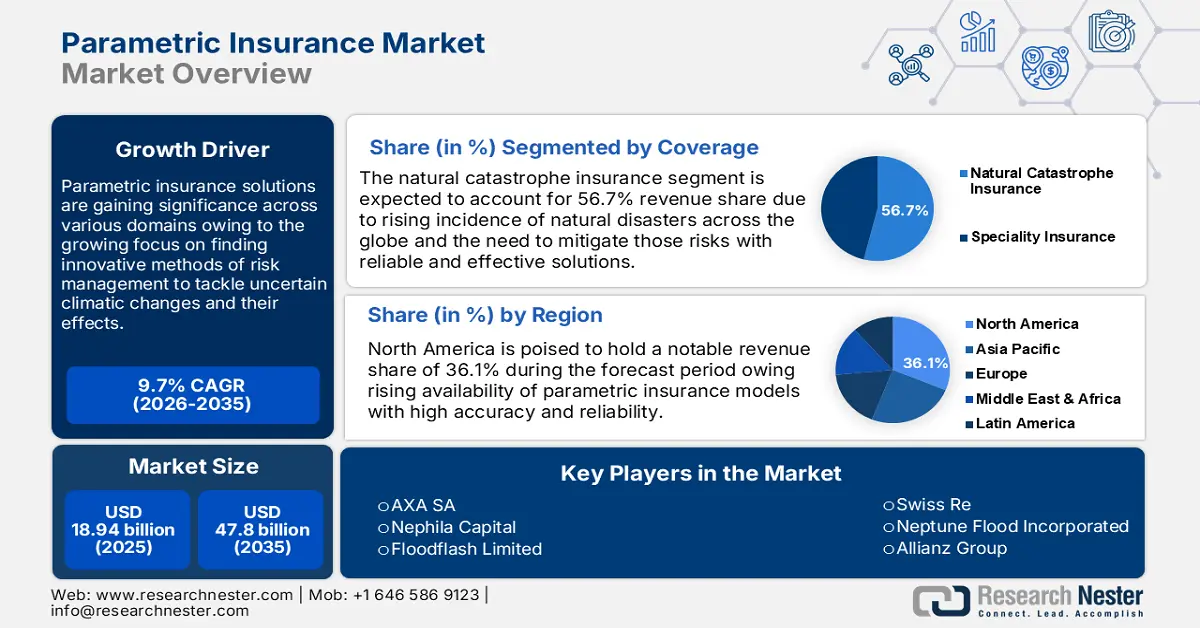
The market is expanding rapidly as these use cases prove viable. According to Global Market Insights, the global parametric insurance market was estimated at USD 19.4 billion in 2025 and is projected to grow to USD 63.8 billion by 2035. This growth is fueled by the increasing digitization of risk data and the integration of IoT sensors that provide the real-time verification required for automated payouts.
Comparing the models
The shift toward parametric structures represents a trade-off between precision and liquidity. Traditional insurance offers precise indemnification based on actual loss verification but suffers from slow settlement times and high administrative costs. Parametric insurance prioritizes speed and transparency, offering faster liquidity but potentially leaving gaps if the trigger parameter does not perfectly correlate with the actual financial damage.
| Feature | Traditional Insurance | Parametric Insurance |
|---|---|---|
| Payout Speed | Weeks to months | Minutes to days |
| Basis Risk | Low (indemnity-based) | Higher (trigger-based) |
| Cost Structure | High administrative overhead | Lower overhead, automated |
| Data Source | Claims adjusters | Oracles, IoT, satellite data |
Basis risk and trigger design flaws
The defining limitation of parametric insurance is basis risk—the structural gap between the event that triggers a payout and the actual financial loss experienced by the policyholder. In traditional insurance, indemnity is based on verified damage. In parametric models, indemnity is based on a data point. When these two metrics diverge, the insurance fails its primary purpose: restoring financial stability.
This mismatch often occurs because triggers are designed for measurability rather than precision. A common example is crop insurance triggered by rainfall levels at a specific weather station. If the station is located three miles from a farm, it may record sufficient rain to trigger a payout, even if the farm received none due to localized microclimates. Conversely, a farm might suffer total crop failure from a brief, intense storm that the station’s hourly average failed to capture, leaving the farmer with no payout despite total loss.
The risk is amplified in DeFi contexts where triggers rely on external oracle data or aggregate indices. A DeFi protocol insured against a "flash crash" might be protected if the broader Bitcoin index drops 10%, but if the specific token held by the protocol only drops 5% due to unique market dynamics, the trigger never fires. The protocol remains exposed to insolvency despite holding a "fully insured" position.
Designing a trigger that minimizes basis risk often requires higher granularity, which increases cost and complexity. The IAIS notes that while parametric insurance can bridge protection gaps, the reliance on predefined parameters means it "may not cover all potential damages" (IAIS, 2024). The trade-off is clear: you gain speed and liquidity, but you sacrifice the precision of traditional indemnity. This is not a flaw in execution, but a feature of the model. Users must understand that they are buying liquidity, not perfect coverage.
Market growth and 2026 outlook
The global parametric insurance market is expanding rapidly, driven by the need for faster liquidity in DeFi and traditional risk transfer. According to Global Market Insights, the market was valued at approximately $19.4 billion in 2025 and is projected to reach $22.6 billion in 2026 [1]. This growth reflects increasing institutional adoption as insurers and reinsurers integrate onchain data feeds to automate payouts.
This trajectory validates parametric insurance as a distinct asset class within decentralized finance. Unlike traditional models that rely on lengthy claims assessments, parametric contracts trigger automatically when predefined conditions are met. This efficiency appeals to institutional players seeking predictable risk management tools without operational bottlenecks. As the market matures, the integration of real-world data oracles will likely further bridge the gap between onchain liquidity and real-world risk events.
What is the difference between traditional insurance and parametric insurance?
Traditional insurance relies on indemnity, meaning payouts are determined by assessing the actual financial loss after a claim is filed. This process involves adjusters, documentation, and often lengthy negotiations, which can delay liquidity when capital is most needed. In contrast, parametric insurance uses a predefined index or trigger, such as a specific earthquake magnitude or weather threshold, to determine payouts.
The core distinction lies in speed versus precision. Parametric models offer faster liquidity because the payout is automated once the external data confirms the trigger event has occurred, eliminating the need for loss adjustment. However, this speed comes at the cost of precision; the payout may not exactly match the actual financial damage incurred, potentially leading to basis risk where the index does not perfectly correlate with individual losses.
While traditional insurance ensures that the indemnity aligns closely with verified damages, it requires longer claims processing times. Parametric insurance can be more cost-effective for specific, high-frequency risks but may not cover all potential damages if the trigger is narrowly defined. For DeFi protocols, this means parametric solutions provide immediate capital for known, measurable risks, whereas traditional models offer broader but slower protection.
No comments yet. Be the first to share your thoughts!