Defining parametric insurance for DeFi
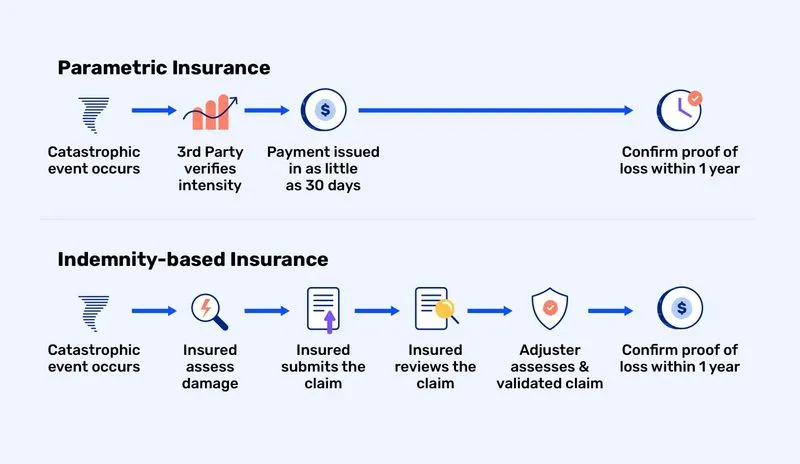
Traditional insurance relies on an indemnity model: you file a claim, an adjuster assesses the damage, and payment follows weeks or months later. In DeFi, where liquidity can vanish in seconds, this latency is often fatal. Parametric insurance replaces subjective loss assessment with trigger-based payouts. The policy pays out automatically when a predefined external metric—called the parametric index—hits a specific threshold.
This index is objective, transparent, and verifiable on-chain. Common parameters include oracle-reported price drops, volatility spikes, or oracle failure durations. If the condition is met, the smart contract releases funds without human intervention. For DeFi protocols, this shift eliminates counterparty risk during the claims process and ensures immediate liquidity when it is most needed.
The model aligns with DeFi’s automated nature. By relying on trusted data sources like Chainlink oracles, the insurance mechanism becomes as trustless as the protocols it protects. The focus shifts from recovering past losses to providing immediate capital for recovery, ensuring protocol solvency during market shocks.
How onchain infrastructure drives parametric payouts
Parametric insurance relies on a technical chain rather than human adjusters. The system interacts between the insurance policy (a smart contract) and an oracle (the bridge to real-world data). When a predefined event occurs, the oracle feeds that data into the smart contract. The contract verifies the data against its parameters and automatically executes the payout if conditions are met.
This automation removes the friction of traditional claims processing. The smart contract holds the liquidity and enforces rules without a central administrator. Oracles are the critical link, fetching data from external sources and delivering it to the blockchain. Because blockchains cannot natively access off-chain data, oracles like Chainlink provide this verification layer, ensuring data accuracy and tamper-resistance.
The system’s reliability depends on oracle integrity. If the data source is compromised, the smart contract may execute the wrong payout. Decentralized oracle networks that aggregate data from multiple sources mitigate single points of failure, allowing parametric insurance to scale across asset classes.
Parametric vs. traditional coverage
The fundamental difference lies in the payout trigger. Traditional policies pay for verified financial losses after an adjuster’s assessment. Parametric policies pay out automatically when a specific threshold is reached, regardless of actual damage incurred.
| Feature | Parametric | Traditional Indemnity |
|---|---|---|
| Payout Trigger | Objective data threshold (e.g., oracle price drop, weather index) | Proof of actual financial loss after investigation |
| Payout Speed | Minutes to days; automated via smart contract | Months to years; manual claims processing |
| Basis Risk | High; payout may not match actual loss | Low; payout aligns with verified damages |
| Administrative Cost | Low; minimal human intervention | High; requires adjusters and legal review |
Speed and Liquidity
The primary advantage is speed. Because payouts are triggered by objective data oracles rather than subjective assessments, funds transfer almost instantly. In DeFi, this is critical; waiting months for a payout is often too late to prevent insolvency. Parametric coverage acts as a liquidity buffer, providing immediate capital when on-chain conditions are met.
Basis Risk vs. Precision
The trade-off for speed is basis risk—the disconnect between the index used to trigger a payout and the actual economic harm. If the index is poorly correlated with your specific position, you face under- or over-compensation. Traditional insurance eliminates basis risk by indemnifying the exact loss, but this precision comes at the cost of complexity and time. For many DeFi applications, accepting some basis risk is a worthy trade-off for immediate capital availability.
Administrative Efficiency
Parametric insurance significantly reduces overhead. There are no claims adjusters or lengthy investigations. The smart contract handles verification and payment automatically, making coverage scalable and cost-effective for smaller, frequent risks.
Key DeFi risks covered by parametric policies
Parametric insurance is best suited for risks that are easily quantifiable and verifiable on-chain. Common applications include:
- Oracle Failure: Payouts triggered if price feeds stop updating or deviate significantly from other sources for a set duration.
- Smart Contract Exploits: While harder to parametrize than price drops, some protocols use on-chain event signatures (e.g., specific function calls or large token transfers) as triggers for emergency funds.
- Market Volatility: Payouts triggered when asset prices drop below certain thresholds, protecting against liquidation cascades.
- Network Outages: Payouts triggered if a blockchain’s block time exceeds a certain limit or if the network is halted for more than a specified period.
Managing basis risk in onchain policies
The primary downside of parametric insurance is basis risk. This occurs when the parametric trigger fires but your actual financial loss is different, or vice versa. In traditional insurance, this gap is filled by adjusters. Onchain, it is a mechanical reality.
Selecting the Right Index
Mitigating basis risk starts with careful index selection. The index must closely track the specific asset or protocol you are protecting. A broad market index like Bitcoin’s price may not accurately reflect the loss of a specific yield-bearing position or a protocol-specific exploit.
For example, insuring a lending protocol’s stablecoin peg requires an index that measures that specific peg’s deviation, not just general market volatility. Using a proxy index that is loosely correlated increases the likelihood of basis risk events.
Data Source Integrity
The reliability of the index depends on the data source. Onchain, this means oracle integrity is paramount. If the oracle reporting the index data is compromised or suffers from latency, the trigger may fire incorrectly. This introduces operational basis risk on top of structural basis risk.
Always verify the oracle’s reputation and the frequency of data updates. A delayed price feed might trigger a payout after the market has already recovered, leaving you with unneeded capital locked in insurance premiums. Conversely, a fast but inaccurate feed could trigger a false positive, draining the pool’s liquidity.
Hedging the Hedge
Sophisticated users often hedge the basis risk itself. This might involve holding a secondary position that profits when the basis widens. For instance, if you are insured via a price index but your loss is tied to volume, you might hedge with a volatility product that correlates with volume drops.
This adds complexity but can neutralize the gap between the trigger and the actual loss, turning insurance into a more robust risk management strategy.
Steps to implement a parametric strategy
Designing a parametric strategy for a DeFi protocol requires shifting from subjective loss assessment to objective data triggers. Follow this workflow to structure and activate coverage.
A well-structured parametric strategy acts as a circuit breaker for your protocol, ensuring liquidity remains intact during crises. By relying on transparent data rather than manual claims, you reduce administrative overhead and accelerate recovery.
Frequently asked questions on parametric insurance
How does parametric insurance work in DeFi?
It uses smart contracts and trusted oracles. An oracle feeds real-world data into the contract, which automatically executes the payout if the data matches defined parameters. For DeFi protocols, this means coverage activates instantly, allowing for rapid liquidity rebalancing without administrative friction.
What is basis risk?
Basis risk is the mismatch between the parametric trigger and your actual financial loss. If the trigger fires but your specific position wasn’t harmed (or vice versa), you may be under- or over-compensated. Careful index selection minimizes this risk.
Can parametric insurance cover smart contract hacks?
Directly covering hacks is complex because "hack" is not a simple on-chain metric. However, protocols can parametrize coverage based on related events, such as a specific token’s price dropping due to a dump following an exploit, or oracle failure durations during an attack.
Is parametric insurance regulated?
Regulation varies by jurisdiction. Many parametric insurance products operate as decentralized financial instruments rather than traditional insurance contracts, which may bypass certain regulatory frameworks but also lack traditional consumer protections. Always consult legal counsel before deploying.
No comments yet. Be the first to share your thoughts!