Why parametric insurance strategy matters now
Traditional insurance relies on indemnity: you file a claim, an adjuster investigates, and you wait weeks for payment. In DeFi, that latency is fatal. When a protocol is exploited or a liquidity pool drains, every second counts. This is why the parametric insurance strategy is shifting from a niche alternative to a core infrastructure requirement for onchain risk management.
Parametric insurance replaces subjective loss assessment with objective triggers. As defined by Aon, it is a risk transfer solution triggered by a specific, pre-defined event rather than actual loss verification [1]. In DeFi, these triggers are typically oracle price drops, smart contract interaction limits, or time-based anomalies. If the data matches the criteria, the payout executes automatically via smart contract code.
This shift offers two distinct advantages for 2026. First, speed: settlements happen in minutes, not months, allowing protocols to stabilize or users to withdraw funds before further damage occurs. Second, transparency: the trigger conditions are public and immutable on-chain. There is no black-box adjuster deciding whether your claim is valid; the code either pays out or it doesn't.
Building the onchain infrastructure
Parametric insurance onchain doesn't rely on claims adjusters; it relies on code. The strategy hinges on three interconnected layers: oracles that feed data, smart contracts that execute logic, and liquidity pools that hold the capital. When a predefined parameter is met, the payout is automatic. This removes the friction of traditional insurance, where disputes over loss severity can delay payments for months.
Oracles as the single source of truth
The oracle layer is the most critical component. In traditional models, an adjuster visits a site to verify damage. Onchain, an oracle verifies a data point. If the protocol uses a weather index, the oracle must pull data from a trusted source like NOAA or a decentralized oracle network like Chainlink. The contract doesn't care why the parameter was triggered—only that it was.
Swiss Re defines parametric insurance as covering the probability of a loss-causing event based on an index, rather than actual loss. This distinction is vital. The oracle doesn't measure the loss; it measures the event. If wind speeds exceed 100 mph, the contract triggers. The oracle's role is to ensure that data feed is tamper-proof and timely.
Smart contracts for automated execution
Once the oracle confirms the parameter, the smart contract executes the payout. There is no manual intervention. The contract holds the premium in escrow and releases it to the policyholder's wallet when the condition is met. This automation ensures speed and transparency. Policyholders can verify the contract code to see exactly under what conditions they will be paid.
The logic is binary: if/then. This eliminates ambiguity. For a DeFi protocol, this means risk is priced and hedged programmatically. If a stablecoin depegs below a certain threshold, a parametric contract can automatically distribute stablecoins to affected users, stabilizing the system without waiting for a governance vote or legal review.
Liquidity layers and capital efficiency
The final layer is the liquidity pool. Unlike traditional insurers that invest premiums in bonds or real estate, parametric pools often hold capital in yield-generating DeFi assets. This capital efficiency is a key benefit. The pool must be large enough to cover the maximum potential payout, but the yield generated can offset the cost of premiums.
Aon has noted that parametric solutions can be structured to cover specific risks with high precision. Onchain, this means designing pools for specific events—like a flash crash or a specific weather event. The liquidity providers are incentivized by the yield, while the insureds get immediate, predictable coverage.
This chart shows the TVL for a major DeFi insurance protocol. The growth in TVL correlates with increased demand for parametric coverage. As more capital flows in, the pools become more robust, allowing for larger coverage limits and lower premiums. The transparency of these pools allows anyone to monitor the health of the insurance layer in real-time.
Key use cases in DeFi protocols
DeFi protocols are moving beyond simple smart contract audits to address the mechanical risks that kill yields. Parametric insurance fills the gap between code execution and human intervention. When a protocol triggers a predefined onchain event, the payout happens automatically. This removes the need for claims adjusters and eliminates the weeks-long delay typical of traditional reinsurance.
Liquidation protection
Borrowers in leveraged lending markets face immediate liquidation when collateral values drop below a threshold. This creates a death spiral for undercollateralized positions. Parametric covers can trigger when the oracle price crosses a specific level, paying out to cover the shortfall before the position is wiped. This stabilizes the borrower’s balance sheet and prevents cascading liquidations that destabilize the protocol.
Yield loss coverage
Yield farming strategies often rely on complex tokenomics that can break during high volatility. If a protocol’s reward rate drops below a set percentage due to a governance vote or market shift, parametric insurance can compensate users for the difference. This ensures that the promised yield remains intact regardless of external market forces, providing a predictable return for liquidity providers.
Flash loan attack mitigation
Flash loan attacks exploit price discrepancies across exchanges in a single transaction. While these attacks are often blocked by circuit breakers, the damage to liquidity pools can be irreversible. Parametric policies can be structured to pay out when a specific volume of unusual trading activity is detected within a block. This provides immediate capital to restore pool balances without waiting for legal recourse or protocol governance votes.

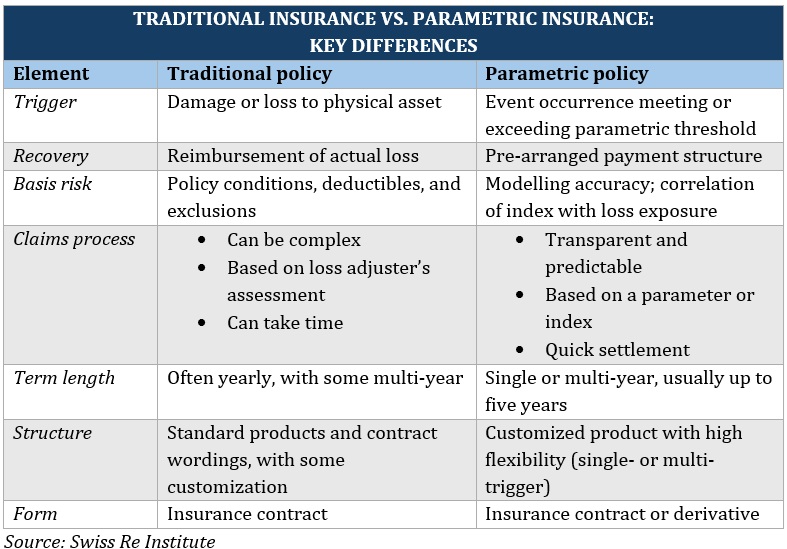
Comparison: Traditional vs. Parametric in DeFi
| Feature | Traditional Insurance | Parametric Insurance |
|---|---|---|
| Payout Speed | Weeks to months | Seconds to minutes |
| Claim Complexity | High (requires proof of loss) | Low (trigger-based) |
| Coverage Transparency | Limited (policy language) | High (onchain code) |
| Assessment Cost | High (adjusters, lawyers) | Low (automated) |
This shift toward automated payouts changes how protocols manage risk. Instead of hoping for a favorable legal outcome, they build financial buffers that activate instantly. This transparency builds trust with users who can verify the trigger conditions themselves on the blockchain.
Designing effective trigger mechanisms
Building a parametric insurance protocol for DeFi starts with the data layer. Your trigger mechanism is the bridge between an on-chain event and a smart contract payout. If that bridge is shaky, you face basis risk—the gap between the actual loss and the insurance payout. The goal is to align the trigger so closely with the real-world or on-chain event that disputes become impossible.
Choosing reliable data sources
The oracle is the heartbeat of your policy. You need data feeds that are tamper-proof and resistant to manipulation. For a liquidity pool insurance product, relying on a single price source is risky. Instead, aggregate data from multiple decentralized oracles like Chainlink or Pyth Network. This ensures that a temporary glitch on one exchange doesn’t trigger a false payout or, worse, leave a protocol underinsured during a volatility spike.
Transparency is non-negotiable. Every data point should be verifiable on-chain. When a protocol uses official, audited data sources, it reduces the administrative overhead of claims. As noted by industry leaders like Swiss Re, the speed of parametric payouts is their primary advantage, but that speed is only valuable if the data source is trusted.
Setting precise trigger thresholds
Thresholds define the "if" in "if this, then that." They must be specific enough to prevent gaming but broad enough to cover genuine systemic risks. For example, if insuring against a flash loan attack, the trigger shouldn’t just be a price drop. It should be a combination of price deviation and unusual transaction volume within a specific block window.
Overly tight triggers lead to frequent, small payouts that drain the insurance pool. Too loose, and the coverage becomes meaningless when a real exploit occurs. The sweet spot requires backtesting against historical attack vectors. By calibrating these thresholds using real DeFi incident data, you create a policy that pays out instantly when it matters most, without exposing the pool to unnecessary volatility.
Liquidity and capital efficiency
Parametric insurance changes how capital is deployed. Traditional models tie up funds in claims processing and administrative overhead. Parametric models remove that friction. When a predefined trigger event occurs, such as a specific price drop or network outage, payouts happen automatically. This speed means capital providers don’t need to hold excess reserves for uncertain claim timelines.
For DeFi protocols, this translates directly to better capital efficiency. Insurers can deploy the same capital across more positions because the risk is quantified and settled instantly. There is no waiting period for adjusters to review damage. The transparency of on-chain verification ensures that every payout is auditable and immediate.
This efficiency lowers the cost of coverage for users. Protocols like Aon highlight that parametric solutions are fast-paying risk transfer tools. In DeFi, "fast-paying" means liquidity isn’t locked in escrow for months. It stays active, earning yield or securing other positions while waiting for the next risk event.
Implementation checklist for protocols
Integrating parametric insurance moves your protocol from reactive damage control to proactive risk management. The goal is simple: automate payouts when onchain or offchain data confirms a loss event, removing the need for claims adjusters and reducing latency from weeks to seconds.
Here is the step-by-step checklist for developers ready to deploy this infrastructure.
Map your risk exposure to measurable data points. For a lending protocol, trigger payouts when the liquidation ratio of a specific asset drops below a safety threshold. Avoid vague conditions; use binary outcomes like "price < $100" or "vulnerability confirmed by audit firm X." Precision prevents disputes and ensures the smart contract executes exactly as intended.

Your trigger is only as good as the data feeding it. Integrate established oracles like Chainlink or Pyth Network that have proven track records in price stability and latency. If using offchain triggers (like weather data), verify the oracle provider’s historical accuracy and resistance to manipulation. The oracle acts as the single source of truth, so its reliability dictates the trustworthiness of the entire insurance pool.
Parametric insurance requires upfront capital to pay out claims. Establish a dedicated liquidity pool, potentially backed by the protocol’s treasury or external liquidity providers. Ensure the pool is sufficiently capitalized to handle worst-case scenarios. Consider staking mechanisms where users can lock assets to earn yield, effectively sharing the risk and reward of the insurance product.
Treat the insurance contract with the same rigor as your core protocol code. Engage reputable security firms to audit the trigger logic, oracle integration, and payout mechanisms. Once audited, deploy the contract to a testnet for final validation before going live on mainnet. Transparency here builds user confidence; publish the audit reports and contract addresses publicly.
By following these steps, you create a system that is both transparent and resilient. Users know exactly what triggers a payout, and the protocol avoids the bureaucratic drag of traditional insurance claims.
Frequently asked: what to check next
How reliable are the oracles that trigger payouts?
Trust in parametric insurance rests entirely on oracle integrity. These data feeds are the bridge between real-world events and onchain execution. If an oracle is compromised or delayed, payouts can fail or trigger incorrectly. Reputable protocols mitigate this by using decentralized oracle networks and cross-verifying data sources, ensuring that a single point of failure doesn’t jeopardize user funds.
What happens if the oracle data is delayed or disputed?
Delays in oracle data can pause payouts, creating a temporary liquidity gap for users expecting immediate relief. To address this, some protocols implement fallback mechanisms or dispute resolution periods where community governance can intervene if data anomalies are detected. This adds a layer of safety but may slightly reduce the speed advantage that makes parametric insurance attractive in the first place.
Can I customize the trigger conditions for my specific risk?
Yes, customization is a core feature of many parametric insurance products. Users can often select specific parameters—such as volatility thresholds, liquidation events, or specific block times—that align with their portfolio’s risk profile. This flexibility allows for precise hedging, though it requires a solid understanding of how these triggers interact with market conditions and protocol mechanics.
No comments yet. Be the first to share your thoughts!