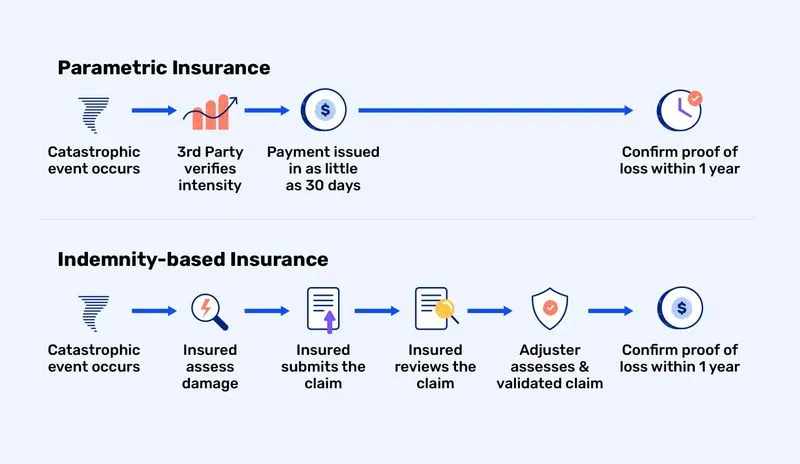
The parametric insurance limits to account for
Parametric insurance solves the speed problem of traditional claims, but it introduces a new trade-off: basis risk. Traditional indemnity insurance pays out based on the actual financial loss you suffer. Parametric insurance pays out based on a predefined trigger—like wind speed, earthquake magnitude, or a specific index value. If the trigger is hit, you get paid, regardless of whether you actually lost anything. If the trigger isn't hit, you get nothing, even if you suffered significant damage.
This structure is why it is often called "index-based" coverage. Swiss Re notes that these solutions cover the probability of a loss-causing event happening, rather than the event's actual financial impact. This distinction is critical for onchain applications. Smart contracts can verify data feeds instantly, but they cannot assess nuanced, subjective loss scenarios. The contract executes only when the oracle reports the threshold has been breached.
The primary constraint is that the index must perfectly align with your exposure. In physical commodities, this might mean a drought index for a specific farm. In DeFi, it could mean a price drop of a specific asset pair on a specific exchange. If the trigger is too loose, you face over-insurance costs. If it is too tight, you face under-insurance gaps where the event causes harm but doesn't meet the strict criteria. Understanding this mismatch is the first step in leveraging parametric solutions for onchain risk transfer.
Parametric insurance choices that change the plan
Parametric Insurance works best as a clear sequence: define the constraint, compare the realistic options, test the tradeoff, and choose the path with the fewest hidden costs. That order keeps the advice usable instead of decorative. After each step, pause long enough to check whether the recommendation still fits the reader's actual situation. If it depends on perfect timing, unusual access, or a best-case budget, include a simpler fallback.
| Factor | What to check | Why it matters |
|---|---|---|
| Fit | Match the option to the primary use case. | A good deal still fails if it does not fit the job. |
| Condition | Verify age, wear, and service history. | Hidden condition issues erase upfront savings. |
| Cost | Compare purchase price with likely upkeep. | The cheapest option is not always the lowest-cost option. |
How to choose the right parametric insurance solution
Choosing parametric coverage is not about picking a single vendor; it is about selecting a risk transfer architecture that fits your specific exposure. Unlike traditional indemnity policies, parametric insurance relies on a predefined trigger—such as wind speed, rainfall levels, or index values—rather than actual loss assessment. This distinction means your decision framework must prioritize data integrity and trigger design over claims negotiation.
When evaluating providers or DeFi protocols, focus on the reliability of the oracle network feeding the data. A parametric policy is only as strong as the data source that triggers it. If the oracle is flawed or the data source is disputed, the payout may be delayed or denied, leaving you exposed despite having coverage.
1. Define the trigger with precision
The trigger is the core of your policy. It must be binary, objective, and verifiable. Avoid vague language like "significant damage." Instead, specify exact thresholds, such as "Category 3 hurricane within 50 miles of the facility." Work with your broker or protocol developer to ensure the trigger aligns with your actual risk, not just the available data. A mismatched trigger is the most common cause of parametric insurance failure.
2. Verify the data source and oracle
For traditional insurers, ask which agencies provide the data (e.g., NOAA, local weather stations). For DeFi solutions, audit the oracle network. Ensure the data feed is decentralized and resistant to manipulation. A single point of failure in the data source can invalidate the entire coverage. Look for providers that use multiple redundant sources to confirm the trigger event.
3. Assess the basis risk
Basis risk occurs when the trigger fires, but you do not suffer a financial loss, or vice versa. For example, if your policy is triggered by wind speed at an airport, but your warehouse is 20 miles away, you might receive a payout even if your property was unaffected, or miss out if the wind was highest near your site but below the airport threshold. Quantify this risk and adjust your coverage amount to account for potential gaps.
4. Compare cost versus speed
Parametric insurance often costs more than traditional indemnity coverage due to the specialized data and structuring fees. However, the value lies in speed. Payouts can occur within days, bypassing months of claims adjustment. Calculate the cost of capital during a disruption. If the speed of recovery outweighs the premium difference, the solution is likely worth the investment.
5. Review the contract and legal structure
Ensure the contract clearly defines the trigger, the data source, and the payout mechanism. For onchain solutions, verify the smart contract code and the governance model for updating data sources. Traditional policies should be reviewed by legal counsel familiar with parametric structures to ensure enforceability in your jurisdiction.
6. Test the scenario
Run a hypothetical scenario through the policy. If the trigger had fired last year, would you have received the payout? Did the amount cover your actual loss? This backtesting helps identify flaws in the trigger design or coverage limits before you commit to the policy.
7. Monitor and adjust
Risk profiles change. Climate patterns shift, and your operations evolve. Review your parametric coverage annually. Adjust triggers if the data sources change or if your risk exposure has shifted. Continuous monitoring ensures your coverage remains relevant and effective.
Common Pitfalls in Parametric Insurance
Parametric insurance transfers risk through automated payouts, but the model has structural weaknesses. Unlike traditional indemnity, it does not compensate for actual financial loss. Instead, it relies on a predefined trigger—such as wind speed or seismic magnitude. This distinction creates basis risk, where a valid financial loss occurs without a trigger activation, or a trigger fires while the insured entity suffers no damage. Understanding these gaps is essential before deploying onchain coverage.
Basis Risk and Model Gaps
The most frequent complaint involves basis risk. If an earthquake measures 6.0 on the Richter scale but your building is reinforced to withstand 7.0, you receive the payout despite no physical damage. Conversely, a 5.9 earthquake might cause significant structural failure, leaving you with zero coverage. This mismatch is inherent to index-based models. You are insuring the event, not the asset. This trade-off simplifies claims processing but removes the nuance of individual loss assessment.
Oracle Reliability and Smart Contract Risk
DeFi parametric products rely on oracles to fetch real-world data. If the oracle provider is compromised or experiences downtime, the smart contract may fail to execute or execute incorrectly. This introduces a layer of counterparty risk distinct from the insurance underwriter. Always audit the oracle source. A delay in data feed can invalidate the entire claim window. Ensure the protocol has a fallback mechanism or a decentralized oracle network to mitigate single points of failure.
Liquidity and Solvency Concerns
Onchain liquidity pools fund parametric payouts. In high-volatility markets, if the pool is undercapitalized, payouts may be delayed or partially filled. Unlike traditional insurers with reinsurance layers, DeFi pools often lack deep capital reserves. Check the pool's total value locked (TVL) relative to the maximum potential payout. A pool with low liquidity relative to its exposure is a high-risk vehicle. Treat these products as high-stakes financial instruments, not traditional safety nets.
No comments yet. Be the first to share your thoughts!