The hard reality of parametric limits to account for
Parametric insurance offers speed and transparency, but it is not a universal fix for every risk scenario. Unlike traditional indemnity policies that pay out based on the actual loss suffered, parametric contracts trigger payments when a predefined external index reaches a specific threshold. This structural difference creates distinct constraints that can leave significant gaps in coverage.
The primary limitation is basis risk. This occurs when the index triggers a payout, but the insured asset does not suffer proportional damage, or vice versa. For example, a crop insurance policy might trigger because rainfall dropped below a certain level in a weather station’s catchment area, yet the farmer’s specific field may have been protected by local irrigation. In this case, the farmer bears the loss despite the "event" occurring. Conversely, if the index fails to trigger due to localized variance, the policyholder receives nothing, even if their property was destroyed.
Another constraint is the reliance on data integrity. Parametric solutions depend entirely on the accuracy and availability of the underlying data source. If the oracle or weather station providing the index data is compromised, delayed, or experiences technical failure, the contract’s execution is jeopardized. In DeFi contexts, this translates to smart contract vulnerabilities or oracle manipulation. If the onchain infrastructure fails to report the correct state, the insurance mechanism breaks down.
These constraints mean parametric insurance works best for risks that are easily measurable, objectively verifiable, and highly correlated with the chosen index. It is less suitable for complex, multi-factor losses where the cause-and-effect relationship is difficult to quantify with a single metric. Readers must carefully evaluate whether their specific risk profile aligns with the available indices before committing capital.
Parametric insurance choices that change the plan
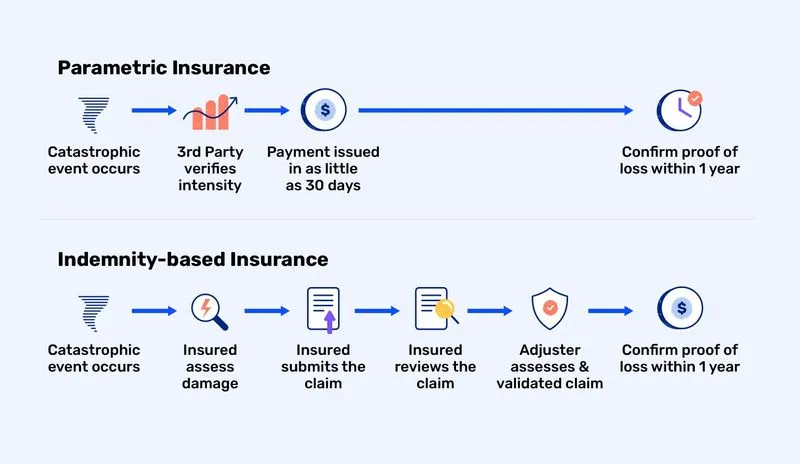
Parametric insurance replaces traditional indemnity with mathematical triggers. Instead of proving actual loss after a disaster, you get paid when a predefined metric—like wind speed, earthquake magnitude, or rainfall depth—crosses a set threshold. This mechanism makes payouts fast and transparent, but it introduces specific structural risks that buyers must evaluate carefully.
The core tension lies in basis risk: the gap between the trigger event and your actual financial loss. If a hurricane hits your region but misses your specific warehouse, the index may still trigger a payout, leaving you with excess liquidity rather than covering your damage. Conversely, if your facility is destroyed by flooding but the official rain gauge is ten miles away and recorded below the threshold, you receive nothing. This disconnect is the primary cost of replacing adjusters with algorithms.
Liquidity and timing are the other major factors. Traditional insurance can take months to settle claims, creating cash flow crises for businesses. Parametric policies, especially those on-chain, can settle in hours or days. This speed is invaluable for maintaining operations during a crisis. However, this efficiency comes at the price of complexity. Designing a policy that accurately reflects your unique risk profile requires precise data modeling and often higher upfront premiums to account for the insurer’s lack of loss-adjustment flexibility.
| Feature | Traditional Indemnity | Parametric Index |
|---|---|---|
| Payout Trigger | Proof of actual loss | Predefined metric threshold |
| Settlement Speed | Weeks to months | Hours to days |
| Basis Risk | Low (pays for actual damage) | High (payout may not match loss) |
| Cost Structure | Premium + Deductible + Adjuster fees | Higher premium, lower admin costs |
| Data Dependency | Physical inspection | Third-party oracle/index data |
When evaluating these tradeoffs, focus on the reliability of the data source. If the trigger relies on a single weather station or a single oracle, the policy is vulnerable to data manipulation or failure. The best parametric policies use multiple data sources or decentralized oracles to ensure the trigger is robust and tamper-proof. This reduces the risk of a false positive or false negative, making the coverage more reliable despite the inherent basis risk.
| Feature | Traditional | Parametric | On-Chain |
|---|---|---|---|
| Speed | Slow | Fast | Instant |
| Transparency | Low | Medium | High |
| Basis Risk | None | High | High |
| Complexity | Low | High | Very High |
Choose the right parametric insurance model
Selecting a parametric solution requires aligning your specific risk exposure with the available onchain infrastructure. Unlike traditional indemnity insurance, which pays out based on actual verified losses, parametric products trigger payouts automatically when a predefined external index hits a set threshold. This distinction determines whether you need a weather index, a volatility index, or a credit default swap structure.
Weather and natural disaster indexes
These products cover physical assets against measurable environmental events. A payout triggers when wind speed exceeds a certain knot count or rainfall falls below a specific millimeter threshold. This is ideal for agriculture, event management, or renewable energy projects where weather directly impacts revenue. The data source is typically a recognized meteorological agency, ensuring the trigger is indisputable.
Market volatility and crypto indexes
For DeFi participants, volatility-based parametric insurance protects against sharp market swings. These products might cover liquidation events or oracle failures. The index tracks token prices or protocol metrics on-chain. If the price of an asset drops by 10% in one hour, the smart contract executes the payout. This model is essential for leveraged traders and liquidity providers seeking protection against black swan events without manual claims processing.
Credit and counterparty indexes
Credit parametric insurance covers default events based on on-chain ledger data. If a borrower’s collateral ratio falls below a safe threshold or a specific protocol is hacked, the index records the event. This is useful for lending platforms and institutional investors who need to hedge against counterparty failure. The transparency of on-chain data makes this model more reliable than traditional credit rating agencies.
Evaluating providers and data sources
When choosing a provider, verify the data oracle first. The integrity of the parametric model depends entirely on the accuracy and tamper-resistance of the data feed. Look for providers that use decentralized oracle networks like Chainlink rather than single-point-of-failure data sources. Additionally, review the smart contract audit history and the liquidity pool backing the policy to ensure payouts can be executed instantly when triggered.
| Feature | Weather Index | Volatility Index | Credit Index |
|---|---|---|---|
| Trigger Source | Meteorological data | On-chain price feeds | On-chain ledger data |
| Best For | Agri, Events, Energy | DeFi Traders, LPs | Lenders, Institutions |
| Data Oracle | External APIs | Decentralized Oracles | Decentralized Oracles |
Watch Out for Weak Parametric Options
Not every onchain insurance product delivers on the promise of real-time risk transfer. Many protocols rely on outdated oracles or opaque trigger logic that can leave you exposed when you need coverage most. Before committing capital, you must audit the underlying data sources and the smart contract’s execution path.
Common Pitfalls in Parametric Design
Lagging Oracles Many DeFi insurance products use price feeds that update too slowly for true parametric triggers. If a market event occurs, a delayed oracle might not reflect the loss condition in time, causing a claim rejection or a significant payout delay. Always check the update frequency and the source of the oracle data.
Ambiguous Trigger Definitions Some protocols define triggers vaguely, such as "significant market volatility." This subjectivity opens the door for disputes or unexpected exclusions. Clear, binary triggers based on specific, verifiable data points are essential for reliable coverage.
Liquidity Shortfalls Even with a valid trigger, a protocol must have sufficient liquidity to pay out claims. Check the reserve ratios and historical payout capacity. A protocol with a perfect trigger but empty reserves is a false promise.
How to Evaluate Options
Use a ComparisonTable to evaluate the top parametric insurance protocols side-by-side. Look for:
- Oracle Source: Is it on-chain and decentralized?
- Trigger Clarity: Is the condition binary and verifiable?
- Payout Speed: What is the average time from trigger to payment?
- Liquidity Depth: Can it handle large-scale claims?
| Protocol | Oracle Source | Trigger Type | Avg. Payout Time | Liquidity Depth |
|---|---|---|---|---|
| Protocol A | Chainlink | Binary (Price Drop) | < 1 hour | High |
| Protocol B | Proprietary | Fuzzy (Volatility) | 24+ hours | Low |
| Protocol C | Multi-Oracle | Binary (Event Hash) | < 30 mins | Medium |
Always prioritize protocols with transparent, on-chain verified triggers and robust liquidity reserves. Avoid products that rely on subjective assessments or opaque data sources.
Parametric insurance: what to check next
Parametric insurance differs from traditional policies because it pays out based on predefined data triggers rather than actual loss assessments. If a hurricane’s wind speed exceeds a set threshold, the policy pays automatically. This removes the need for lengthy claims adjusters and provides immediate liquidity when it matters most.
How does onchain infrastructure improve risk transfer?
Onchain infrastructure, such as decentralized oracle networks, provides the transparent and tamper-proof data feeds required to trigger smart contracts. By anchoring triggers to immutable blockchain data, parametric insurance eliminates counterparty risk and ensures that payouts occur instantly once conditions are met, without human intervention.
What are the main limitations of parametric coverage?
The primary limitation is basis risk, which occurs when the trigger data does not perfectly match your actual financial loss. For example, a policy might trigger based on regional rainfall that does not account for local drainage issues. Additionally, these products offer limited customization compared to traditional insurance, as the contract terms are fixed by the data index.
Is parametric insurance regulated?
Regulation varies significantly by jurisdiction and asset class. Traditional parametric products often fall under standard insurance regulations, while onchain derivatives may face securities or commodities oversight. Always verify the legal standing of the provider and the specific regulatory framework governing the smart contract in your region before deploying capital.
No comments yet. Be the first to share your thoughts!